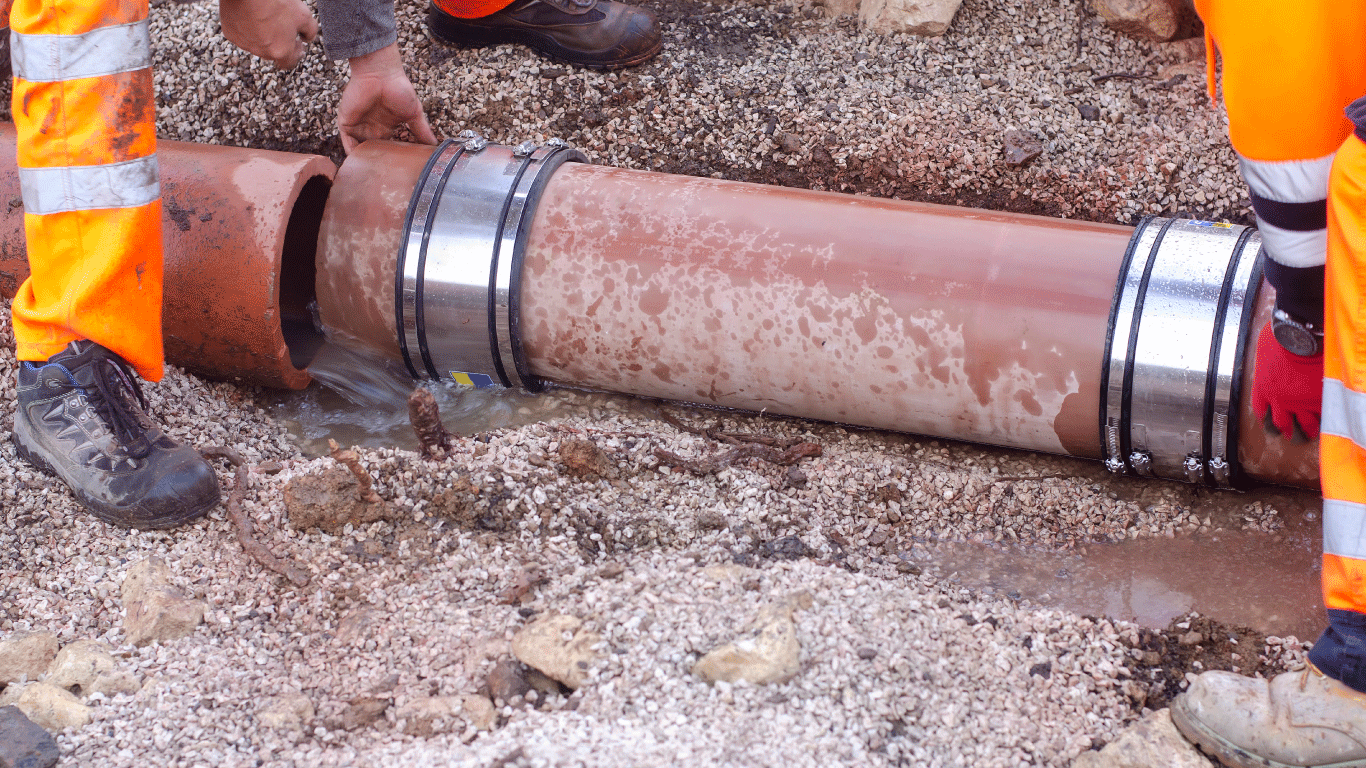
Libra provides septic tank emptying in Chatham and the surrounding area, using licensed vacuum tankers, fully documented waste disposal and appointments booked around you. Whether you need a one-off empty, an emergency call-out or a regular scheduled service, we can get a tanker to you.
Chatham itself is largely on mains drainage, but the fringe of the town where it climbs onto the downs is not. Properties around Capstone, Blue Bell Hill, Bredhurst and the lanes off Lordswood still run on septic tanks, and several older houses in the town have cesspools that predate the sewer network.
Every visit is a full service, not a quick partial pump-out. Here is exactly what you get:
We cover Chatham itself and the villages and hamlets around it, including Luton, Walderslade, Lordswood, Capstone, Blue Bell Hill, Princes Park, Weedswood, Davis Estate, Boxley and Bredhurst. Our tankers work across the ME4 and ME5 postcode areas.
If your property sits just outside that list, call us anyway — we regularly work a fair distance beyond our core patch, and if we are already in the area we can often fit you in the same day.
The usual guidance is at least once a year, and under the General Binding Rules an annual empty is effectively the minimum standard unless the manufacturer specifies otherwise. In practice, the right interval depends on the size of your tank, how many people live in the property, how much water you use, and how well the drainage field is coping.
The ground rises sharply from the Medway onto chalk downland behind the town. Chalk drains quickly, which is good news for a soakaway but means poorly maintained tanks can let untreated effluent reach groundwater fast.
| Property / system | Typical interval | Why |
| 1–2 people, standard 2,700–3,000 litre septic tank | 12–18 months | Low daily flow, solids build slowly |
| 3–4 people, standard septic tank | 9–12 months | The most common domestic scenario |
| 5+ people, or heavy water use | 6–9 months | Higher flow reduces settlement time |
| Property on heavy clay or with a high water table | 6–9 months | Poor percolation keeps liquid levels high |
Cesspool/cesspit (sealed, no outlet) | 4–8 weeks | Nothing leaves the tank — it fills at the rate you use water |
| Package treatment plant | 6–12 months de-sludge | Follow the manufacturer’s schedule |
| Holiday let, campsite or seasonal use | Seasonal schedule | Heavy summer load, light winter load |
These are guides, not guarantees. After your first visit we will give you a realistic interval based on what was actually in the tank.
If waste is backing up indoors, stop using water and call Libra on 01634 562 222. Every flush, shower and washing machine cycle adds to a tank that has nowhere left to put it.
Since January 2020, the General Binding Rules for small sewage discharges in England have made it clear that a septic tank must not discharge to a ditch, stream, river or any other surface water. It must discharge to ground through a properly functioning drainage field. If your tank still discharges to a watercourse, it has to be replaced or upgraded — and if you sell the property, that is normally dealt with before completion.
The rules also require the system to be maintained properly: emptied at least once a year, or as often as the manufacturer specifies, by a registered waste carrier — and you are expected to keep the records that prove it.
The downland above Chatham falls within a groundwater Source Protection Zone feeding public water supply boreholes, so tanks in this area are held to a higher standard and regular emptying with a proper waste transfer note matters.
Libra is a registered waste carrier. Every empty we carry out is disposed of at a permitted site and comes with a duty of care waste transfer note. Keep them somewhere safe: they are what you produce if the Environment Agency asks, and what a buyer’s solicitor will ask for when you come to sell.
We are a local operation, not a national call centre passing your job to a subcontractor.
At least once a year as a baseline. Depending on your household size, tank capacity and how well the drainage field copes with local ground conditions, properties around Chatham often need emptying every six to twelve months. We will give you a realistic interval after the first visit.
A standard domestic septic tank empty usually takes 30 to 60 minutes on site. A larger tank, a long hose run or a badly overdue tank will take longer.
If waste leaves the tank and soaks away into the ground, it is a septic tank. If nothing leaves and the tank simply fills, it is a cesspool – and it will need emptying far more often, sometimes monthly. Our driver can tell you which you have on the first visit, and we will set a realistic schedule from there.
Not necessarily, as long as we have clear access to the tank and the manhole covers, and somewhere to park the tanker. Many customers leave a gate unlocked and we send the paperwork afterwards.
It is taken away by a registered waste carrier to a permitted treatment site, and you receive a duty of care waste transfer note recording exactly where it went.
Yes. We hold capacity for urgent jobs and can usually attend the same day or next day. If waste is backing up into the property, stop using water and call us straight away.
Getting a tanker booked is simple. Call Libra on 01634 562 222, or email enquiries@librautility.services with your postcode, rough tank size and whether this is routine or urgent. We will confirm a price and a slot, turn up when we say we will, empty the tank properly and leave you with the paperwork.
Septic tank emptying in Chatham — licensed, documented and done right. Call 01634 562 222, today.